|
SARGASSO
SEA - 15 FACTS
Please use our
A-Z to
navigate this site or return HOME
SARGASSUM
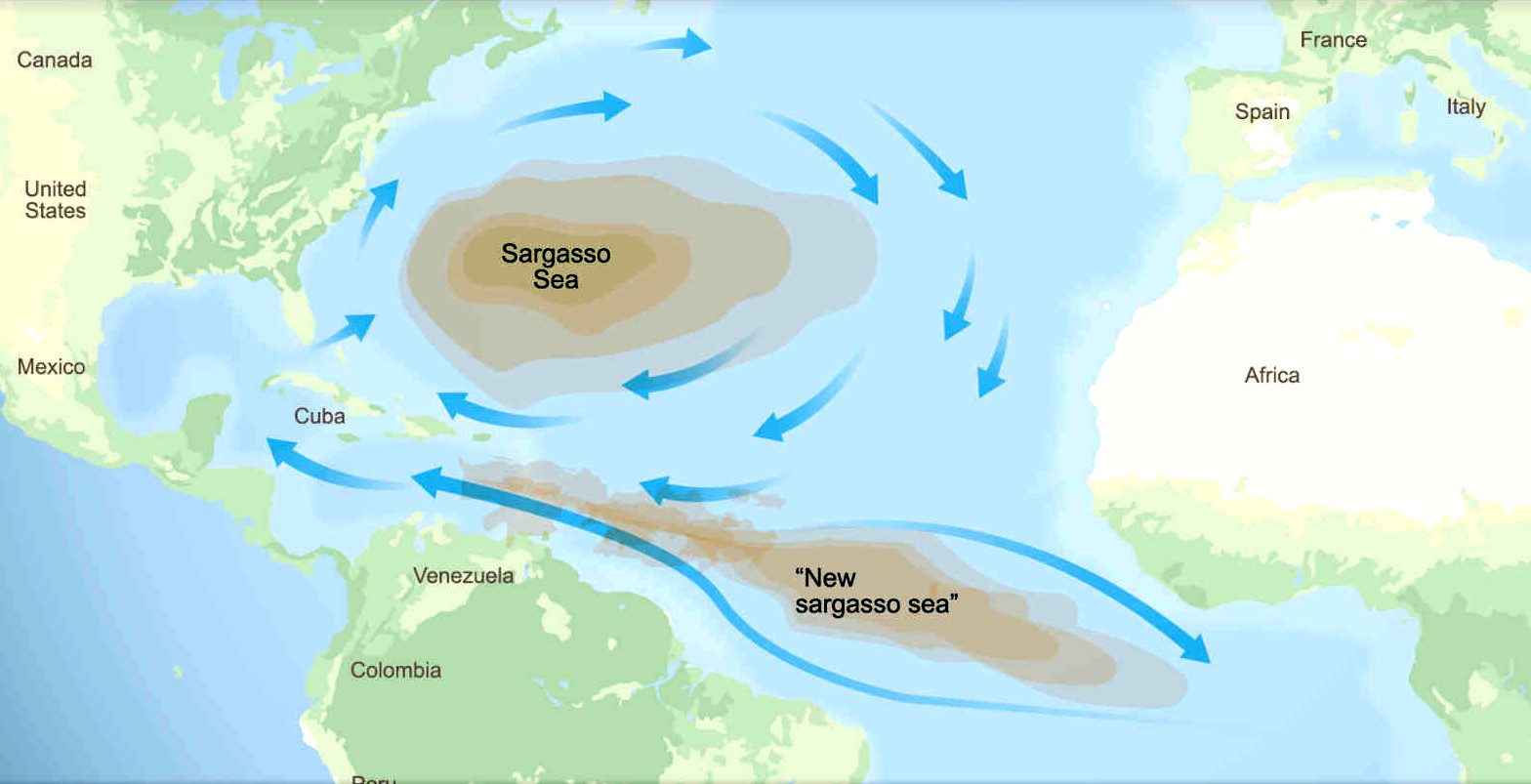
- The giant brown seaweed, having shown that it can spread
from North to South Atlantic oceans, could spread to the
Indian and Pacific
oceans as a potentially invasive species.
The proof of which (as a theory) is satellite pictures, and
changing wind states. The spread witnessed here, could just as
easily migrate between oceans, and thence to the bays and seas
within those oceans.
What
is generally regarded as an amazing natural phenomenon as the Sargasso sea,
is not actually a sea at all as we understand it, because a
"sea" is a bounded area of water. Whereas, we are
talking about a large mass of macro algae, or seaweed,
floating in the Atlantic
Ocean, as a revolving mass, or gyre.
This
has been the focus of attention by scientists for several centuries.
Even though it has long been known how and why it was formed, it does not become less
astounding. Unfortunately, the phenomenon is almost impossible to take a look at it with your own eyes, unless you’re a professional
sailor or diver.
TOP FIFTEEN FACTS ABOUT THE SARGASSO SEA
1. There’s no wind above waters. The reason for this is that
there’s a zone of high atmospheric pressure in this region. In the era of sailing ships, such calm was really deadly. That’s why the Sargasso sea had a very bad reputation for
so long. It was even called the “ship eater”.
2. The area of the Sargasso sea is approximately 8 times larger than the area of France. However, this is
an approximation only. An exact area of this 'organic sea' depends on the ocean
currents and time of year.
3. This is the only sea on Earth that has no shores.
(At the moment)
4. The water temperature in the Sargasso sea is never lower than 18С degrees (+64F degrees).
5. Its water mass rotates clockwise slowly but continuously, full of
algae and other life forms.
6. The first European to visit this amazing place was the famous
Christopher
Columbus.
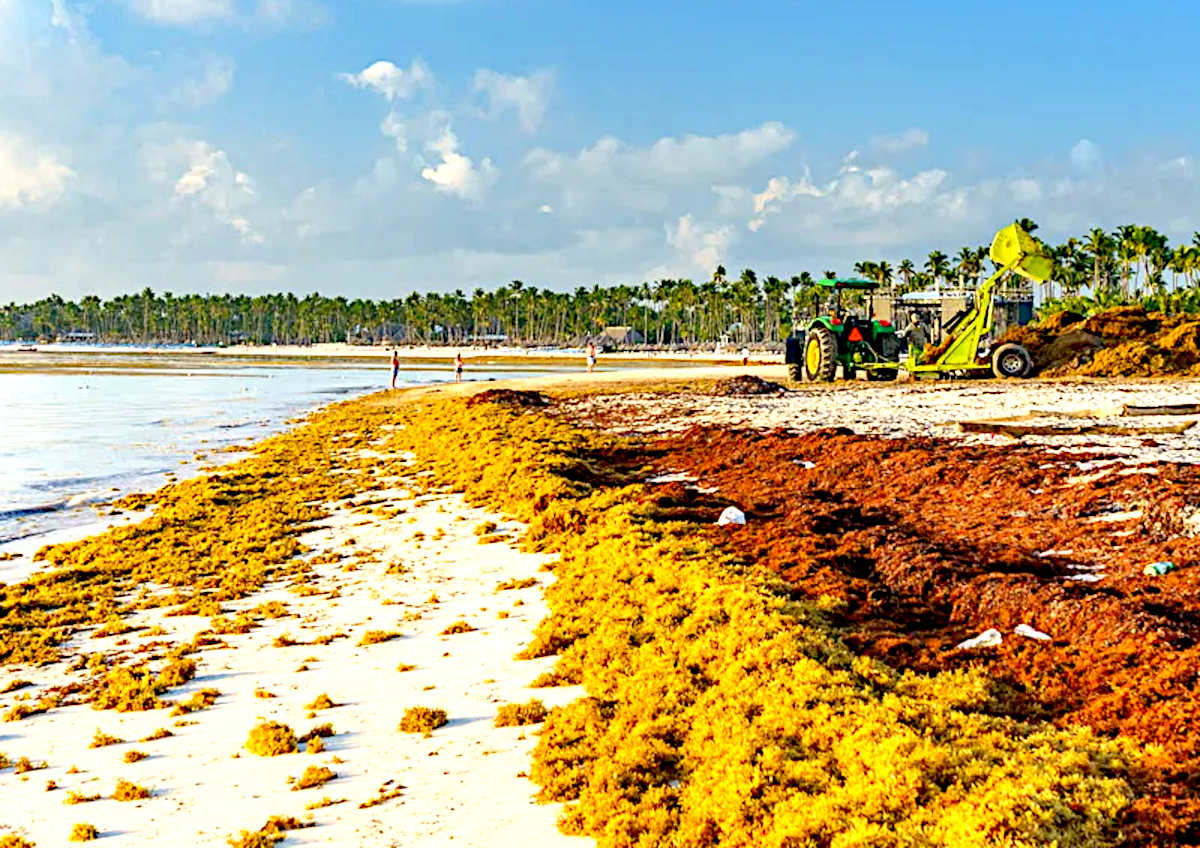
7. Algae mass in the Sargasso sea is more or less dependent on the month. Their total mass ranges from about 5 to 11 million tons. Though, the New (equatorial) Sargasso Sea divests some 20 plus million tons per year. Normally ending up in the Caribbean Sea.
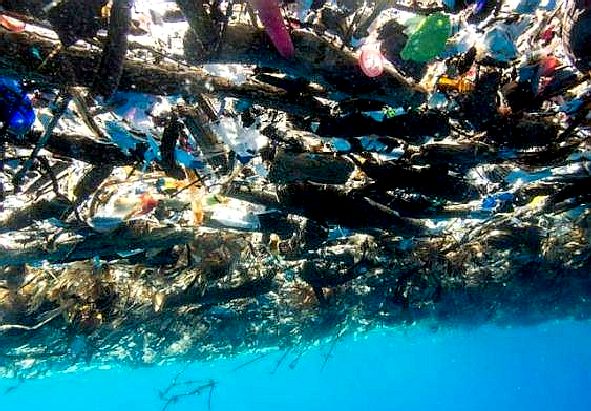
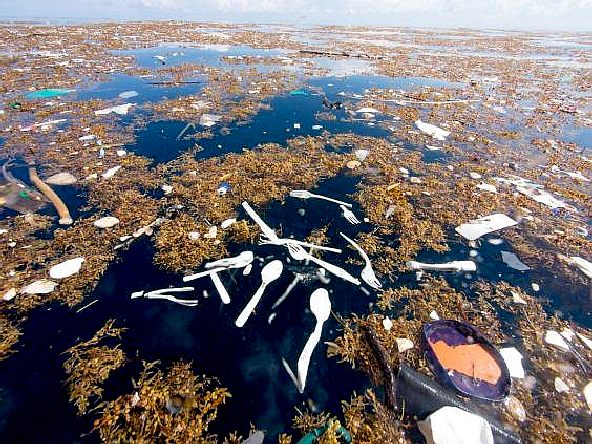
8. Sea currents bring here a lot of debris from different parts of the ocean, and nowadays there has formed a real garbage island.
9. The water level in the Sargasso sea is higher than in the ocean around 1-2 meters. The reason for this phenomenon is clearly
understood as yet: save that ocean currents bring a lot of water here.
10. Eels living near the shores of Europe and the United States swim
here to lay their roes, despite the fact that they spend about 3 years
to make this journey.
11. The diversity of life in the Sargasso Sea is much lower than in any other. There’s a lot of biomass, but the number of different life forms living here is low.
12. About two thousand unique microorganisms, previously unknown, have been found in the Sargasso Sea.
13. The depth of the Sargasso sea is from 4 to almost 7 kilometers (from 2,5 to 4,3 miles).
14. The famous and mysterious Bermuda triangle is also situated here.
15. The only species of large algae living here is
sargassum.
LIKELY
SEA/OCEAN STUDY AREAS:
Arabian
Sea
Atlantic
- North &
South
Equatorial
Banda
Ceram Molucca & Timor Seas
Bay
of Bengal
Celebes
Sea
Gulf
of Guinea
Gulf
of Thailand
Indian
Ocean
Java
Sea
Pacific
Ocean - North & South, Equatorial
Belt (Costa Rica, Ecuador,
Panama regions)
Philippine
Sea
South
China Sea
Seas
and oceans in equatorial latitudes could become inundated with sargassum
(macro
algae) if the rafts of floating seaweed
manage to navigate
less hospitable barriers, such as colder regions. Which at the
moment, Cape Horn and the Cape
of Good Hope appear to be barriers to invasion.
PLASTIC
TIDE - These amazing pictures of a giant plastic tide were
taken by Caroline Power. Please note how plastic and sargassum
intertwine, creating a separation problem.
LINKS
& REFERENCE
https://www.
This
website is provided on a free basis as a public information
service. copyright © Cleaner
Oceans Foundation Ltd (COFL) (Company No: 4674774)
August 2022. Solar
Studios, BN271RF, United Kingdom.
COFL
is a charity without share capital. The names Amphimax™
RiverVax™
and SeaVax™
are trademarks.
|